Modern computers are undoubtedly faster, prettier and immeasurably more capable, yet I sometimes wonder how much we’ve really moved on. We still spend an astonishing amount of time acting as the switchboard operator ourselves. We open browsers to reach websites. Launch email clients to communicate. Search through folders to find our own documents. Dig through settings menus that we’ve somehow memorised over the years.
Somewhere along the way we’ve accepted that operating a computer is simply part of modern life. I’m beginning to wonder if that’s about to change.
I’ve spent most of my adult life around computers. I learned on Windows, spent almost twenty years happily living in Debian-based Linux distributions, and these days I write primarily on a Mac. Each taught me something different. Windows taught me patience. Linux taught me how computers actually work. macOS reminded me that thoughtful design can remove a surprising amount of friction.
It also taught me something else. Most people don’t care. Not because they lack curiosity, but because they have lives to live.
The vast majority of people aren’t interested in operating systems. They aren’t comparing file systems over coffee or debating the merits of different desktop environments. They simply want to communicate with family, book a holiday, pay a bill, edit a photo or write an email. The operating system is just the thing standing between them and what they were actually trying to do.
People don’t stay with Windows or macOS because they passionately love the underlying architecture. They stay because after twenty years they know where everything is. Their fingers remember the shortcuts. Their eyes instinctively know where to look. Switching operating systems isn’t really changing software. It’s declaring war on decades of muscle memory.
For over forty years we’ve been trying to make operating systems easier to learn. What if that’s the wrong problem?
What if the next great leap in computing isn’t a better operating system, but the last one we ever consciously have to operate?
That sounds like a bold claim, perhaps even a slightly ridiculous one. Yet over the last few months I’ve found myself returning to the same question again and again.
Not, “Which operating system is best?”
But, “Why am I still operating one at all?”
But questions have a habit of following me around.
Once I’d started wondering why I was still “operating” a computer in 2026, I began seeing examples everywhere. Every browser tab, every settings menu, every file I misplaced in Downloads because future Keith would “definitely organise it later.” None of these things were what I actually wanted to do. They were simply the rituals I’d learned in order to persuade a very capable machine to help me.
Which made me wonder if I’d been looking at the problem from the wrong direction. I’ve often wondered whether the real problem isn’t intelligence at all.
It’s translation.
Living in other countries has taught me that you can have two perfectly intelligent people standing a metre apart, both wanting exactly the same outcome, yet still struggle because of a language barrier. Nobody is stupid. Nobody is wrong. You’re simply speaking different languages and relying on a translator to bridge the gap. Computers have always felt a little like that.
They’re astonishingly capable machines. The smartphone in my pocket contains incomparably more computing power than the systems that guided Apollo astronauts to the Moon, yet I still find myself asking questions like, “Why won’t this file open?” or watching autocorrect confidently replace the word I actually wanted with one I definitely didn’t.
The intelligence isn’t the problem. The translation layer is.
For decades we’ve improved that translation. Command lines became graphical interfaces. Keyboards gained mice. Mice became touchscreens. Touchscreens learned gestures. Voice assistants arrived. Each generation narrowed the gap between human intent and machine execution.
Perhaps the next step isn’t another translation layer. Perhaps it’s removing the need for one altogether. If the problem really is translation, then perhaps we’ve been thinking about operating systems backwards.
For decades we’ve treated the operating system as the centre of our computing experience. Everything begins there. Open the browser. Launch the email client. Find the document. Install the application. Learn another interface. Remember another shortcut.
We’ve become so accustomed to this way of thinking that it feels inevitable. I’m not sure it is.
When I renovated our house, I never once asked what brand of electrical cable had been run through the walls. I don’t know who manufactured the water pipes, and unless something starts leaking, I probably never will. They’re essential, but they’re infrastructure. Their success is measured by how rarely I have to think about them.
I wonder if operating systems are heading towards the same future. Not disappearing. Becoming infrastructure.
The browser doesn’t vanish, nor does email or search. They simply stop being places I consciously visit. They become suppliers of services, quietly working together behind the scenes while something else sits between me and the complexity.
Not another operating system.
An assistant.
One that doesn’t particularly care whether the answer comes from a browser, a search engine, an email server or a document stored somewhere in the cloud. Those become implementation details rather than decisions I need to make.
Instead, I simply express an intention.
“Present the world in the language I understand.”
That might mean translating an email. It might mean quietly converting a government website, a restaurant menu, a PDF or an instruction manual. The point is that I shouldn’t need to care. The software decides how to achieve the goal because, for the first time, it understands the goal rather than the application.
The same applies everywhere else.
“I’m meeting my accountant tomorrow. What documents am I likely to need?”
“Find the most reliable answer to this question and explain why you trust it.”
“Book a hotel within walking distance of the conference, but avoid chains if there’s a well-reviewed independent option.”
Notice what’s missing. There’s no mention of browsers, search engines, email clients, or even operating systems.
Those decisions have quietly moved into the walls alongside the plumbing and the electrical wiring. They’re still there. They’re still essential. We simply stop thinking about them because they’re no longer where the friction lives.
Perhaps that’s what the last operating system really is. Not the final version of Windows, macOS or Linux. The last one we ever have to consciously operate.
If all of this still sounds a little abstract, it’s because we’ve spent decades thinking in terms of software instead of outcomes.
Imagine an ordinary Tuesday.
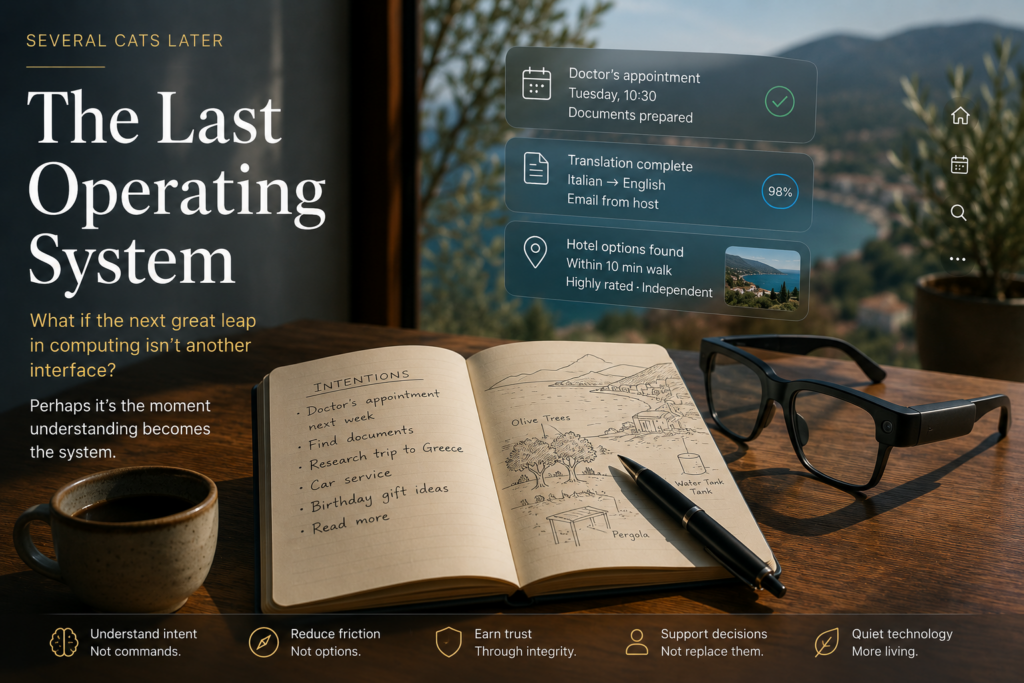
You have a doctor’s appointment next week. A birthday coming up. The car needs servicing at some point this month. You promised yourself you’d finally book that holiday. There’s an email in a language you don’t speak, and somewhere on your computer is a document you know you downloaded… you just can’t remember where. It’s probably in Downloads, patiently waiting for future-you to become a more organised person.
None of these are particularly difficult problems.
They’re friction.
Today’s computers ask us to solve each one separately. Open the calendar. Search your email. Visit a comparison website. Read the reviews. Open another tab. Download another PDF. Somewhere along the way you’ve forgotten what you were trying to do in the first place.
An assistant starts from the opposite direction.
“Your annual vehicle inspection is due next month. Would you like me to find a few well-reviewed garages nearby?”
“You’ve got a doctor’s appointment on Tuesday. Based on previous appointments, you usually need these documents. I’ve already found them if you’d like to check them.”
“Your friend’s birthday is in two weeks. Remember they mentioned taking up a new hobby? I found a few gift ideas that might fit. One of them happens to be on sale, if you’d like to have a look.”
Notice something important. Nothing has been booked. Nothing has been bought. Nothing has been shared. The assistant hasn’t taken control. It’s simply removed the friction between intention and action. That distinction matters a great deal.
One of the more understandable concerns about increasingly capable assistants is that they’ll quietly start making decisions on our behalf. I think that would be the wrong direction entirely. The assistant shouldn’t replace judgement; it should support it.
It shouldn’t say:
“Book this hotel.”
It should say:
“I found three hotels that seem to match what you’ve chosen in the past. This one is slightly more expensive, but it’s within walking distance and previous guests consistently mention how quiet it is. Would you like to compare them?”
It shouldn’t say:
“Your friend wants this.”
It should say:
“Last time you met, they mentioned starting a new hobby. I thought that might be a useful place to begin looking.”
It shouldn’t pretend certainty where none exists.
It should explain its reasoning, acknowledge uncertainty, and then ask.
“Does this look right to you?”
Perhaps that’s the real measure of a good assistant. Not that it quietly gets on with things while we hope for the best. But that it knows when to stop, explain what it’s thinking, and leave the final decision exactly where it belongs. With us.
If this happens, the consequences reach far beyond operating systems. Browsers, search engines and email clients don’t disappear; they quietly become infrastructure. Software companies may find themselves competing less for our attention and more for our assistant’s trust. That changes the incentive completely. For the first time in a long time, simply building the better product might become a competitive advantage again. Heaven forbid.
Perhaps that’s because we’re also reaching the limits of the term Operating System. For decades it described exactly what these platforms did: they helped us operate increasingly capable machines.
I’m beginning to wonder whether the next generation deserves a different name.
Not Operating Systems.
Understanding Systems.
The acronym made me smile when I first noticed it—OS quietly becoming US—but the more I thought about it, the more appropriate it seemed. The shift isn’t really about smarter software or more capable hardware. It’s about moving from systems that expect us to learn them, to systems that spend a lifetime learning us.
Perhaps that’s the real transition we’re witnessing.
Advertising becomes less valuable than reputation. Interfaces become less important than outcomes. The internet doesn’t vanish. It simply becomes another layer that our assistant navigates on our behalf.
Perhaps none of this happens.
Perhaps twenty years from now we’ll still have desktops covered in icons, folders called New Folder (27), and a Downloads directory that has quietly become an accidental historical archive.
I suspect, though, that something more fundamental is changing.
For most of the history of computing, progress has meant making technology easier for people to understand. Every decade gave us better interfaces, cleaner menus, more intuitive icons and new ways of translating our intentions into something a machine could execute. It was a remarkable achievement.
I’m simply wondering whether it was the destination, or merely the next stepping stone.
What if the next great leap isn’t another interface?
What if it’s the moment we stop needing one?
Not because technology has become magical.
Not because our assistants have become infallible.
But because, for the first time, understanding becomes more important than the interface itself.
If that’s true, then the real story isn’t about operating systems.
It’s about friction.
Every menu we don’t have to search. Every password we don’t have to remember. Every browser tab we don’t have to open. Every document we don’t have to hunt for. Individually they’re tiny inconveniences. Together they become a surprising amount of our lives.
Perhaps the greatest contribution our assistants will make won’t be helping us do more.
It’ll be quietly helping us do less.
Less searching.
Less clicking.
Less translating.
Less operating.
More living.
If that happens, we probably won’t remember the operating system that made it possible.
And perhaps that’s exactly the point.
The greatest interface ever designed may eventually be the one we stop noticing.
Perhaps the last operating system won’t be remembered as the moment technology became more intelligent.
It may simply be remembered as the moment understanding became the system.